

The hours after a complicated delivery or surgery often decide the outcome. Here is how a Gynae ICU protects mothers.
A Gynae ICU is a specialised hospital unit built for mothers and gynaecological patients whose condition needs intensive monitoring and immediate medical response — beyond what a regular ward can provide. It brings together life-support equipment, continuous monitoring, and an ICU-trained team in one place, so a high-risk situation can be met with the right care at the right moment.
When does a mother need one?
Not every delivery or gynaecological case needs ICU care, but for those that do, immediate access can be lifesaving. Common reasons include:
- Severe bleeding during or after delivery (postpartum haemorrhage)
- Pre-eclampsia or eclampsia (dangerously high blood pressure)
- Complications following a C-section or major gynaecological surgery
- Sepsis or severe infection
- Breathing difficulty requiring ventilator support
What happens inside a Gynae ICU
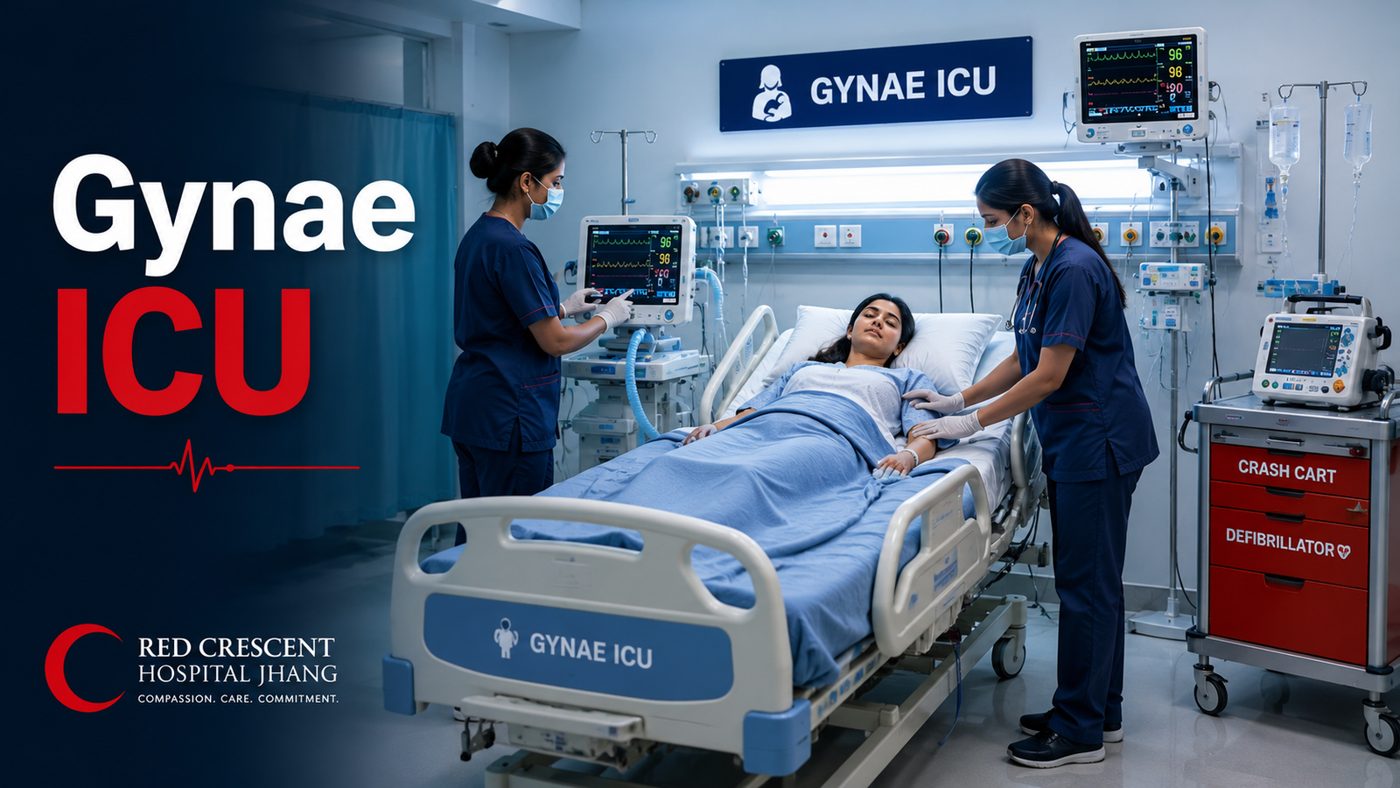
Care inside the unit is built around one priority: catching a change in condition before it becomes an emergency. Ventilators support patients who can't breathe adequately on their own, while continuous cardiac monitors track heart rate and rhythm around the clock. A designated crash cart with a defibrillator stays on standby for the moments that call for immediate action.
Every bed is connected to a continuous oxygen supply, and direct lift access means a patient can be moved in and out of the unit without delay. Every vital sign — blood pressure, oxygen levels, heart rate — is tracked in real time, so the ICU-trained team can respond the instant something changes.
In a Gynae ICU, every minute is managed with precision — because a mother's stability is the whole family's peace of mind.
Red Crescent Hospital Jhang
Why it matters
The hours after a complicated delivery or surgery are often the ones that decide the outcome. A well-equipped, well-staffed Gynae ICU gives high-risk mothers the stability and medical support they need to recover safely — and gives families the reassurance that she is in capable hands during the most uncertain moments.
- 5 dedicated ICU beds with 2 ventilators
- Direct access with lift for rapid transfer
- Designated crash cart with defibrillator
- Continuous cardiac monitoring
- Oxygen supply at every bed
- ICU-trained nursing staff, 24/7